
Content governance: deciding what you are allowed to publish
Content governance is the system that decides what your organisation is allowed to publish. It covers five things: the standards content must meet, the check that applies them, the person who owns the decision, the record that proves it, and the measurement that shows whether the standard is holding. It matters now because making content became cheap while approving it did not.
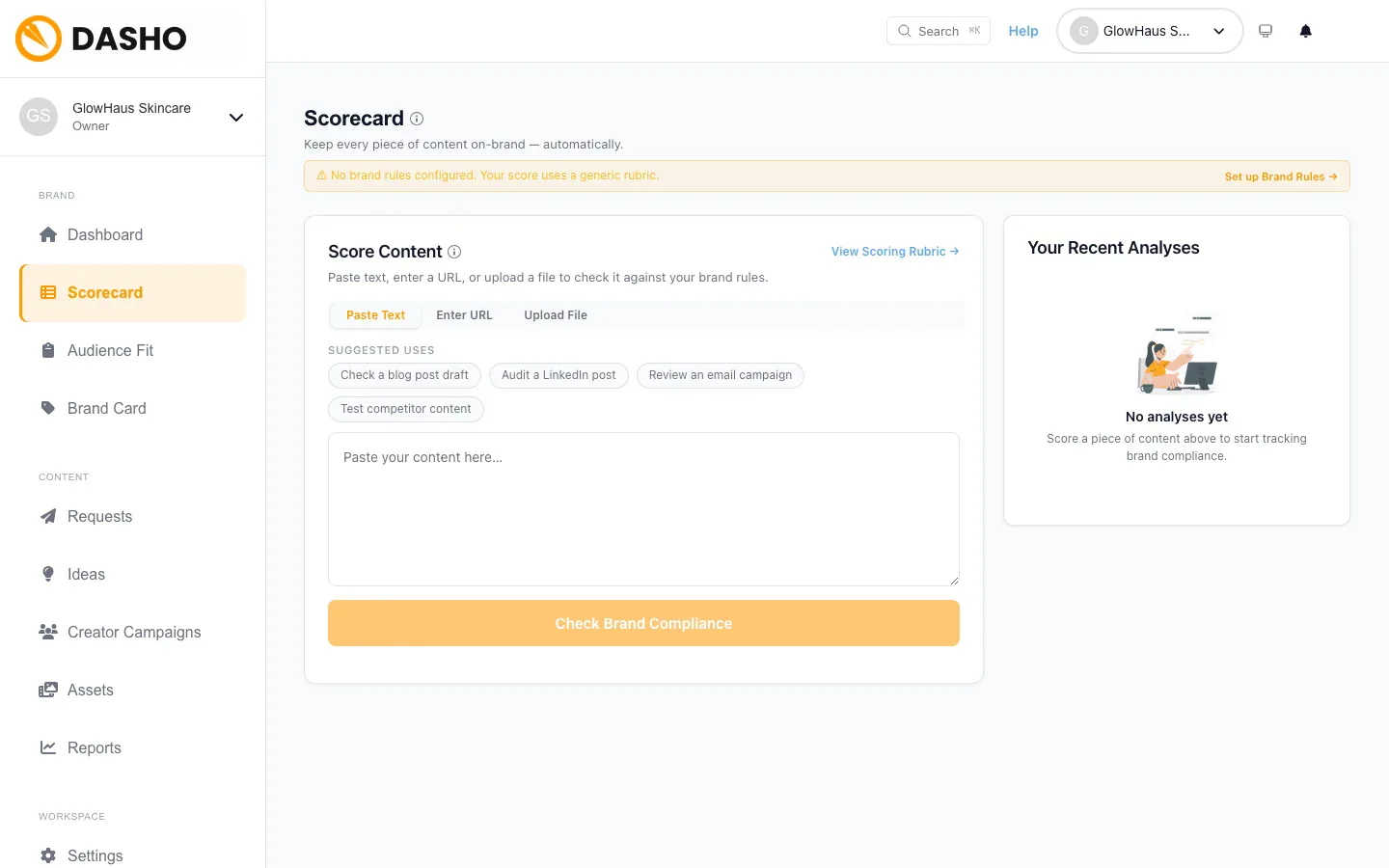
Standards applied to every draft, not to the subset one reviewer can reach.
Why content governance became urgent
For most of the last decade, making a piece of content was the expensive part and checking it was the cheap part, tucked into somebody's afternoon. Generative tools inverted that. Producing a draft is now close to free and effectively unlimited, while reviewing one costs exactly what it always did, because a person still has to read the thing and decide.
So the queue grows on the making side and stays the same width on the checking side. Nobody decides that; it happens quietly while a team is celebrating how much faster they have become. Content governance is the discipline that closes the gap, by making the standard active rather than aspirational.
In our 2026 interviews with marketing leaders, nearly every team relied on a single approver, and most discovered off-standard content only after it had already published.
Standards live in a document. One reviewer checks what they can reach. Everything else ships unchecked and nobody can say later what was approved or why.
Standards live in one place, every draft is scored against them automatically, approval has a named owner, and the record survives the people who made the decision.
What content governance actually covers
A programme missing any one of these is not governance. It is a preference that people follow when they have time.
-
Standards
The rules content has to meet: voice, tone, claims you are allowed to make, disclosures you are required to carry.
-
Checking
Something has to apply the standards to every piece, not to the subset one reviewer has time to read.
-
Ownership
A named person accountable for each decision, and a defined path from brief to sign-off.
-
Record
Evidence of what was checked, what changed and who approved it, months after the fact.
-
Measurement
Whether the standard is actually holding across brands and over time, rather than a feeling that it is.
Each part, mapped to how it works in practice
Dasho is built around this list. Here is which part of the platform covers each one.
Brand Card
Each brand’s standards are written down once and become the thing every draft is measured against, instead of living in a PDF nobody opens.
Content Scorecard
Every draft is scored against the standards before a person reviews it, so off-tone copy and unsupported claims surface early.
Governed workspace
Briefs, drafts and approvals sit in one place per brand, so review is a step in the flow rather than a scramble across inboxes.
Audit trail
Every score, edit and approval is logged, so "who approved this, and against which rules" has an answer.
Reports and governance trend
Scores roll up across brands and weeks, so drift is visible as a line on a chart before it is visible to a customer.
See how the parts fit together on the platform overview, or read the narrower question of what brand governance is.
Content governance and brand governance are not the same thing
The two get used interchangeably and they should not be. Brand governance asks whether a piece sounds and looks like your brand. Content governance asks the larger question: should this exist at all, is it accurate, is it allowed, who signed it off, and can you prove it later.
The distinction has teeth in regulated categories. A beauty caption can be perfectly on-brand, in the right voice, with the right colours, and still carry a claim a regulator would act on. Brand governance passes it. Content governance is the frame that catches it, because it includes the claims and disclosure rules alongside the voice rules. That is why brand compliance software and a content approval workflow are parts of the same system rather than separate purchases.
Where content governance breaks in practice
Three failures show up repeatedly, and none of them is caused by carelessness.
The standard is written but not applied. Guidelines exist as a document. Nobody runs a draft against them line by line, so the standard is applied to whichever pieces the reviewer reaches.
One person is the whole system. A single senior approver becomes the bottleneck, and when that person is on leave, either everything stops or everything ships unchecked.
There is no record. Months later, when a claim is questioned, nobody can say which version was approved, against which rules, by whom. The decision existed but the evidence did not survive it.
How to start
Start with one brand rather than all of them. Write the standards down, including the claims you may not make and the disclosures you must carry. Put the check in front of human review so problems surface before anyone spends time editing. Name who approves. Keep the record automatically rather than by discipline. Then measure whether scores improve over a few weeks, and only add the second brand once the first one holds.
You can do the first part of that in Dasho on a free workspace: define one Brand Card and score real, already-published content against it before you pay for anything. See plans and pricing.
Content governance questions
What is content governance?
Content governance is the system that decides what your organisation is allowed to publish: the standards content must meet, who checks it, who approves it, and what record is kept. It covers the whole lifecycle, from brief to archive. Where brand governance focuses on staying on-brand, content governance is the wider frame that also covers accuracy, regulatory claims, disclosure, ownership and accountability.
What is the difference between content governance and brand governance?
Brand governance is a part of content governance. Brand governance asks whether a piece sounds and looks like your brand. Content governance asks the larger question: should this exist, is it accurate, is it allowed, who signed it off, and can we prove it later. A team can be perfectly on-brand and still publish a claim a regulator would act on, which is why the wider frame matters.
Why does content governance matter more now than it used to?
Because making content stopped being the bottleneck. When a team produced five posts a week, one person could read them all. Generative tools moved that to fifty, while the review step still costs exactly what it always did, because a human still has to read and decide. Governance is what closes the gap between how fast content can now be made and how fast it can responsibly be approved.
Who owns content governance in a company?
In most teams nobody owns it explicitly, which is the problem. It usually falls to whoever approves content in practice, often one senior marketer who becomes the bottleneck. A working model names an owner for the standards, gives the checking to software so it applies to everything, and keeps human judgment for the decisions that genuinely need it.
Do we need software for content governance?
You need standards, checking, ownership and a record. Small teams can hold those in a document and a person. The point at which software becomes necessary is when the volume of content exceeds what your reviewers can read, because at that point an unwritten standard is applied to a shrinking share of what you publish.
How do you start a content governance programme?
Write your standards down for one brand, including the claims you may not make and the disclosures you must carry. Put a check in front of review so problems surface before a person spends time. Name who approves and make that path explicit. Keep the record. Then measure whether scores improve, and only expand to the next brand once the first one holds.