
Echelon Philippines 2026: Making Things Is Free, Permission Is Not
 Fleire Castro, Founder & CEO, Dasho · September 1, 2026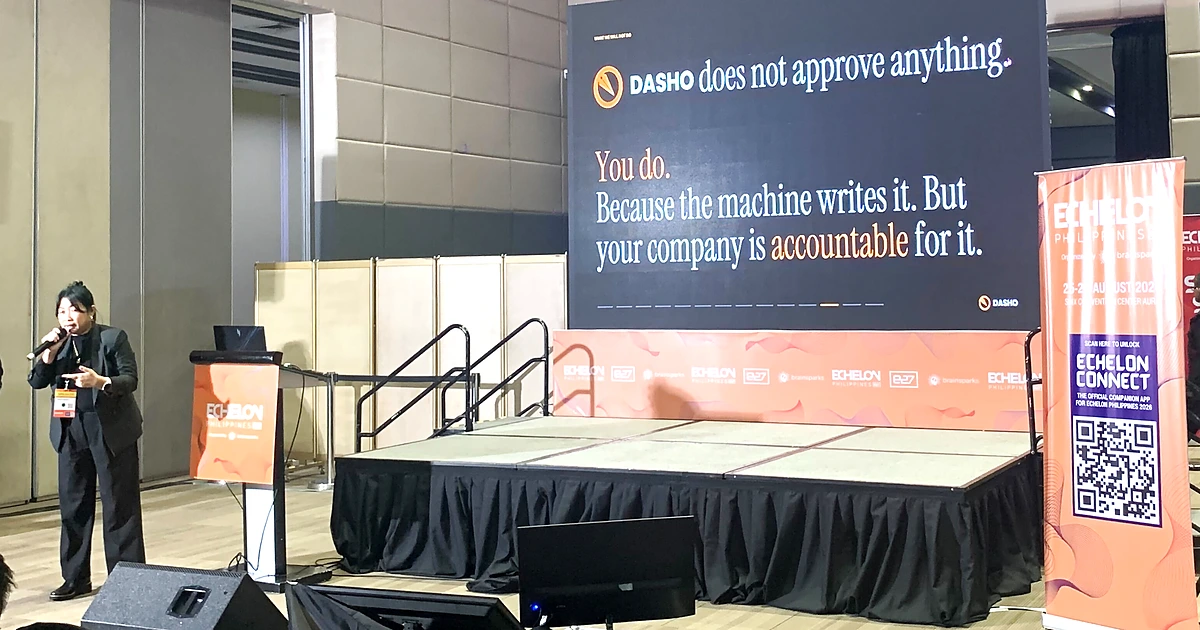
Everything I sold for sixteen years is free now. What is left is permission — who is allowed to publish, who says yes, and who carries it when it is wrong.
I opened at Echelon with the least comfortable sentence I know how to say about my own career.
Everything I sold for sixteen years can now be made by anyone, for free, in seconds. Blog posts. Captions. Campaign copy. Whole content calendars. I built an agency on that. The product I sold does not have a price any more.
That was our twenty minutes at Echelon Philippines 2026. SMX Convention Center Aura, 25 and 26 August, organised by e27 and Brainsparks. Our booth sat in the Spotlight Zone both days. I spoke on day two.
I am writing this from inside the thing I am describing.
The number we put on the screen
We built software that reads a piece of content and checks it against the brand’s own rules. Not our taste. Rules somebody at that company sat down and wrote.
Then we counted what came back.
1,414 pieces of published marketing have been through it. 826 of those got a score. 538 of the scored pieces came in under 70 out of 100.
Two in three. Not drafts. Published, professional, signed-off work, breaking rules the brand wrote for itself.
I did not put that number up to sell anything. I checked, and it was worse than I expected.
How many of yours would clear 70? Has anyone at your company ever counted? Would you publish the number if they had?
The slide carried one more line, and it is the one I actually care about: those in-house teams were not being careless. THE REVIEW LOAD CHANGED UNDERNEATH THEM.
Approving never scaled
The whole shape of the problem fits on one slide. From five posts to fifty, but approving did not scale.
Making a post used to be the expensive part. Checking it was cheap, tucked into somebody’s afternoon between other work. AI inverted that in about eighteen months. Making is now close to free and effectively unlimited, while checking costs exactly what it always did, because a person still has to read the thing and decide.
So the queue grows on the make side and stays the same width on the check side. Who did you hire this year to absorb that? Anyone?
Nobody decided that. It happened while everyone was busy celebrating the speed.
When was the last time your approval process got faster? Not your production. Your approval.
Forty words, four claims
I put a skincare caption on the screen. Forty words long. Four of them were claims a regulator would act on: clinically proven, dermatologist approved, 100% safe, and FDA approved, which is not a status that exists for cosmetics in the first place.
That caption was our own demo copy, not a real brand’s post. I said so from the stage and I will say it again here.
The prices next to it were real. Under the Consumer Act, the maximum for false advertising is ₱5,000. Under the FDA Act, advertising a health product without authority reaches ₱5,000,000. Same forty words. The number that applies depends on what the regulator decides you were selling.
Not my words
I did not want the room taking my word for any of this, so I put up somebody else’s.
This is a marketing director at one of our clients, speaking on a recorded call. I have kept her words and taken her name off.
Sometimes we fail to see some of the regulatory side of things. So sometimes it’s already posted on the platform, and then we’ll get flagged that this term should not be used. So we have to take that down and then do a lot of revisions.
Already posted. Then flagged. Then taken down.
Everyone in that hall had had that week. Have you had that week?
A supplement brand renamed a senator’s street
The example that landed hardest in that room was not mine and not hypothetical.
In July 2024 a supplement brand renamed Gil Puyat Avenue to “Gil Tulog” on street signage, to sell melatonin. The mayor ordered the signs down. The senator’s great-granddaughter called it disrespect. The brand, Wellspring, apologised in public. The Philippine Star covered it on 23 July 2024.
No clinic. No injury. One marketing decision.
That is what exposure actually looks like here. Not a lawsuit. A brand explaining itself in public for something that got approved because nobody stopped to ask.
The rules are being written somewhere else
On 2 August 2026 the European Union’s transparency obligation for AI-generated content came into force. The companies that build the models have said they will attach machine-readable marks to supported outputs themselves.
Read that arrangement slowly. The thing that writes your caption is also the thing that signs it. Europe decides the signature matters. And whether any of it reaches a Filipino brand selling to Filipinos gets settled in a room nobody at Echelon has ever been in.
Nobody in that hall was consulted. Nobody in that hall usually is.
Who is the gatekeeper deciding which markets the labelling rules cover? When that gets decided, is anyone from here in the room?
To be exact about what we do and do not do: we do not detect those marks. No provider has published a way for anyone outside to read them. When they do, we will.
We opened the gate ourselves
Here is the part I am not proud of. AI did not break in. We wheeled it in — I wheeled it in, and I was first in line.
It made everything faster. Then it made everything cheap. Then it made the thing I sold worth nothing.
In 2021 I stood on a stage a lot like that one and said content is king.
I was right for about eighteen months.
What we built instead
We took the agency apart and built software around the humans doing the work. AI does the writing. Humans still have to approve.
I did not explain how the checking works, and I would not now either. Anyone in that room could write something that scores content — that is a weekend. The rulebook is not a weekend. Every rule cites a real regulation with a real document number, and when the regulator moves, the rulebook moves that same week, or the check is a lie and you find out about it in public. In the two months after I spoke, the Philippine FDA published 502 advisories, and 373 of those name a specific unregistered product. Eight a day. Over the same two months the rules themselves barely moved: no administrative order, and two circulars in the whole of 2026. Two clocks, running at completely different speeds. Following both is not the overhead of the business. It IS the business.
The slide I would put on a wall said it plainest:
Dasho does not approve anything. You do. Because the machine writes it. But your company is accountable for it.
Permission is the asset
Making things is free. Permission is the thing with value now, and somebody is going to hold it.
So who holds permission for your brand right now? Do you know what they check, or only that somebody signs off?
Right now permission is held by whoever writes the rules, and the rules are not written here. We take the liability, somebody else takes the upside. That is not new for us. It is the same shape as every industry we have been downstream of, for as long as I have been working.
The difference this time is that the rules are software.
And software, we can write.
Come and see
Thank you to e27 and Brainsparks for the stage, and to everyone who walked up to booth S9 holding something they had already published.
That was the whole ask on stage and it stands here. Bring something live. Not a draft, something you were proud of. Put it through Dasho.
I will not tell you it is good. I will tell you what it breaks.
Fleire Castro is the founder of Dasho, the brand governance platform for multi-brand marketing teams and agencies. She writes on brand governance, content operations, and keeping brands on-message at scale — drawing on interviews with marketing leaders across beauty, CPG, retail, and agencies.
See how Dasho keeps every brand on-message
Brief, draft, govern, and approve on-brand content in one workspace.